
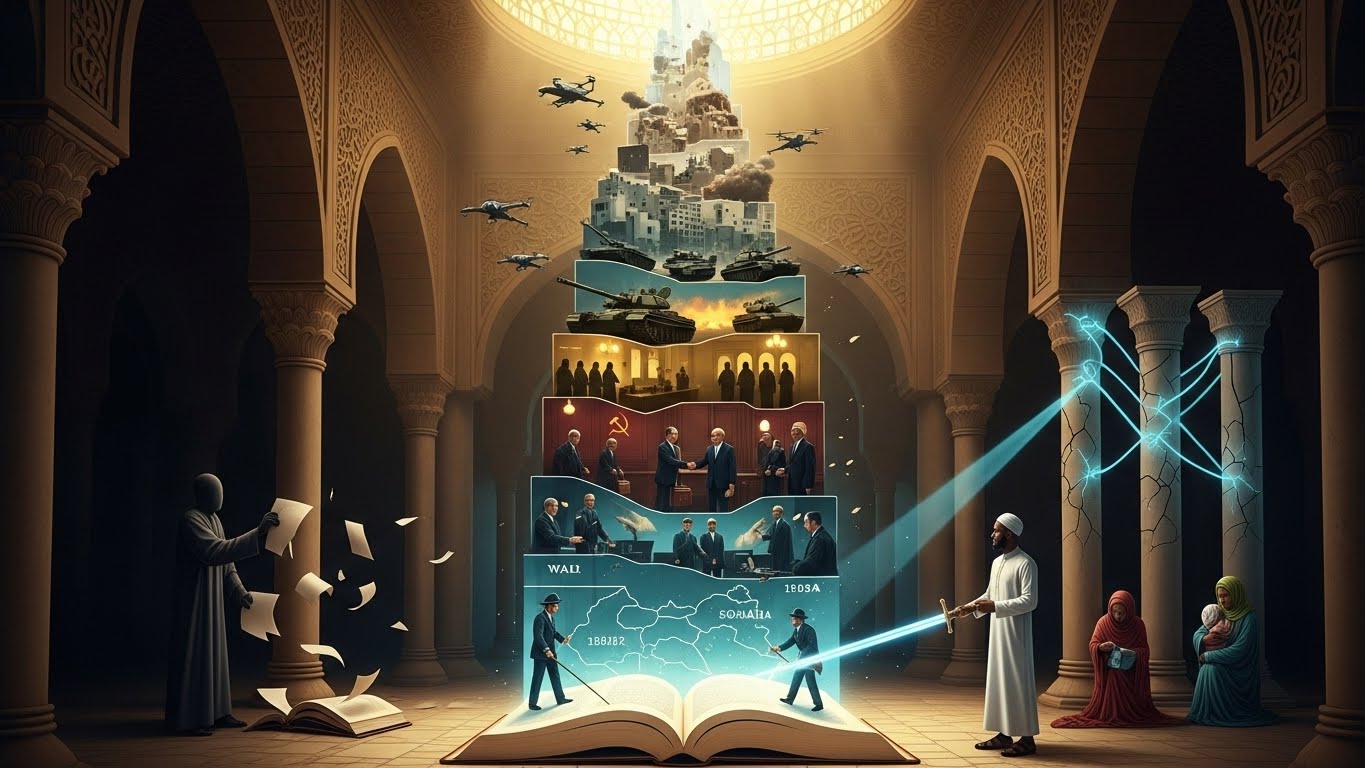
When Donald Trump described Somalia as “garbage” and claimed that its people had “contributed nothing,” many instinctively labelled his remarks racist. But racism is too small, too shallow, too local a term for the worldview such words reveal. Trump’s insult is not an isolated outburst; it is a window into a civilisational logic that has shaped centuries of Western engagement with the Muslim world. And nowhere is this clearer, or more painfully documented, than in the story of Somalia.
Somalia’s wounds were not self-inflicted. They were engineered, layered, and widened by foreign powers whose interventions reshaped the country again and again. Understanding this history is essential not merely to defend Somalia’s name, but to expose a system of domination that has long depended on portraying Muslim societies as inherently broken, inferior or chaotic. Somalia is not an exception. It is an example. And like Palestine and Sudan, its struggle cannot be separated from the wider struggle of the Ummah for freedom and self-determination.
Chapter 1: Before the Ruins—The First Fracture
Long before the world saw images of famine, war and displacement, Somalia was fractured by colonial rule. Britain and Italy carved the region into competing territories, shaping borders and institutions not for Somali unity but for imperial convenience. Communities were divided, political cultures were distorted and economic structures were designed for extraction, not development.
At independence in 1960, the new nation inherited a state never built for its own coherence. It inherited borders drawn by outsiders, institutional weaknesses embedded by foreign rule and a political landscape already shaped by decades of manipulation. The seeds of later instability were planted long before Somalis had any control over their fate.
Chapter 2: A Cold War Pawn
When a military coup brought Mohamed Siad Barre to power in 1969, Somalia entered the global chessboard of the Cold War. The country first aligned with the Soviet Union, then pivoted to the United States after the Soviet alliance with Ethiopia deepened. For Washington, Somalia was not a nation of Muslims seeking stability; it was a strategic asset on the Horn of Africa.
American military aid flowed into the country despite clear evidence of repression and abuse. The dictatorship was propped up because it served Western interests. When the Cold War ended and Somalia was no longer useful, support vanished overnight. The regime collapsed, institutions crumbled and the country descended into conflict. Somalia did not fall by itself. It was dropped.
Chapter 3: Humanitarian Theatre and Abandonment
In the early 1990s, famine and civil war devastated Somalia. Foreign troops arrived, not purely out of compassion, but also out of political self-interest. Operation Restore Hope brought soldiers, television cameras and a narrative of humanitarian heroism. But the mission quickly became militarised. Heavy-handed raids, clashes with armed groups and abuses committed by some contingents worsened instability.
After the Battle of Mogadishu became a public relations disaster in the United States, foreign forces withdrew abruptly. Somalia was left not only with deeper wounds but with a new damaging narrative: that its people were violent, ungovernable and beyond help. The structural causes of instability—decades of external interference—disappeared from the Western story. Blame was shifted onto the victims.
Chapter 4: A Glimpse of Stability, Then the Hammer Falls
Despite years of chaos, Somalis attempted to rebuild their society from within. The Islamic Courts Union (ICU), formed by scholars, elders and community leaders, restored significant stability in Mogadishu in the early 2000s. Crime fell. Markets revived. Roadblocks vanished. For ordinary Muslims in Somalia, the ICU’s governance was a rare moment of dignity and order.
But Western powers viewed this emergence of a functioning Muslim-led system as a strategic threat. Instead of supporting local resilience, the CIA funded Mogadishu warlords under the banner of counterterrorism. These warlords, infamous for brutality, reignited conflict and destabilised the city. When the ICU eventually unified control of the south, the United States backed an Ethiopian invasion to remove it. Tens of thousands were killed, over a million displaced and a promising internal trajectory was crushed.
Out of this chaos, the ICU’s youth militia evolved into al-Shabaab. It did not rise because Somalia rejected stability. It rose because foreign intervention dismantled a functioning Muslim governance model and radicalised a generation.
Chapter 5: A Nation Turned Into a Battlefield
Following the invasion, Somalia became a permanent stage for proxy warfare. Ethiopian and Kenyan troops, AMISOM forces, Western-funded Somali units and American drones turned the country into a militarised zone shaped by external agendas rather than Somali needs.Drone strikes killed civilians, homes were destroyed and entire families were left without justice or acknowledgement. Somalia became a laboratory for counterterrorism: a place where strategies were tested, where Muslim suffering was collateral and where narratives of inherent Somali violence justified endless intervention.
This is the Somalia the world sees today: a nation exhausted by wars it did not start, invasions it did not choose and narratives it did not write.
Chapter 6: Naming the Insult
After colonial partition, Cold War manipulation, humanitarian abandonment, warlord funding, proxy invasions and drone warfare—after all of this—Trump looks at the devastation and calls Somalia “garbage.” He declares that Somalis have “contributed nothing.”
This is not simply wrong. It is a moral inversion. A civilisation destabilises a nation, destroys its institutions, fragments its society and then presents the ruins as evidence of Somali inferiority. It is the same narrative used during the Crusades, colonialism, the Atlantic slave trade and the modern War on Terror: break the Muslim world, erase the cause, blame the survivors.
And this is why calling Somalia garbage is not racism. Racism is too limited a term for a worldview that positions the white Western world as the centre of human civilisation and casts Muslim societies as inherently inferior, perpetually chaotic and in need of domination. Trump did not invent this worldview. He simply said it aloud.
Calling Somalia garbage is not racist. It is… white supremacist—a precise description of a civilisational logic that justifies intervention abroad and superiority at home.
Chapter X: Controlling Our Story Is the First Step Towards Liberation
This chapter is the moment we are living.
Somalia’s struggle is not separate from Palestine’s struggle. Sudan’s struggle is not separate from Somalia’s. Every wound inflicted on the Muslim world has followed the same pattern: divide our lands, fragment our identity, weaken our unity and then convince us that our struggles are disconnected, isolated and purely local. The devastation in Mogadishu, the genocide in Gaza and the collapse of Sudan are all expressions of the same system of domination—a system that has thrived for centuries through divide-and-conquer strategies that shattered the unity of the Ummah.
But what was divided can be reunited. What was fragmented can be repaired. The Muslim world will not liberate itself through diplomacy alone or through isolated national movements. Liberation begins with a shift in consciousness: the recognition that all our struggles are one struggle, that every front of oppression is connected and that the dignity of the Ummah will only be restored when we reclaim our narrative and reassert our unity.
The West maintained its dominance by controlling the story: the story of civilisation, the story of progress, the story of who is worthy and who is disposable. Our liberation begins when we seize the pen back. When we expose the roots of the lies told about us. When we refuse to accept the narratives crafted to keep us weak, dependent and divided.
Somalia is not garbage. Palestine is not a crisis. Sudan is not a failed project. These are nations of the Ummah struggling under the same structure of oppression and they will rise in the same liberation.
The road to Muslim self-determination begins with one act: reclaiming our story under our shared Muslim identity.