
Author: Muhammad Qasim
Among Muslims today, one slogan has become increasingly common:
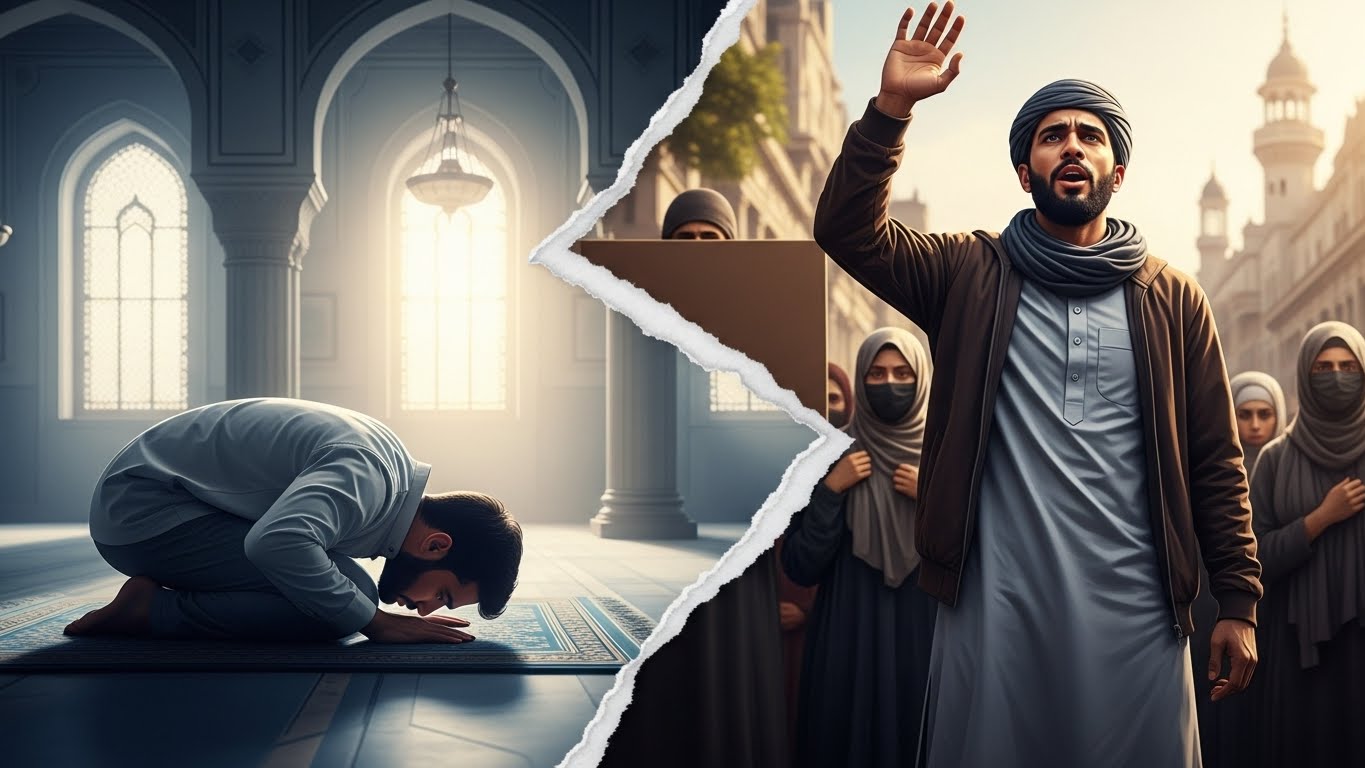
“The Ummah doesn’t even pray Fajr, how can we talk about politics?”
It sounds profound. It sounds pious. But upon closer inspection, it is neither accurate nor Islamic. It is a false dilemma, unsupported by the Qur’ān, Sunnah, or the positions of classical scholars.
This article examines the logical flaws behind this statement, provides Qur’ānic and Prophetic evidence, and explains why personal spiritual shortcomings never negate communal obligations.
1. The Qur’ān Does Not Make Political Responsibility Conditional on Perfect Personal Piety
Allah says:
“Thus We have made you a middle nation so that you may be witnesses over mankind.” Surah al-Baqarah, 2:143
Notice: Allah designates the Ummah as witnesses over humanity, a global moral responsibility—without adding any condition such as “once you all pray Fajr properly.”
Tafsīr of Ibn Kathīr
Ibn Kathīr explains that this verse establishes the Muslim Ummah as “just and chosen” so that they uphold truth, enjoin good, forbid evil, and guide mankind—not after reaching perfection, but because that is their divinely mandated role.
2. The Sunnah Shows That Muslims Act Collectively Even When Individuals Fall Short
The Prophet (pbuh) never delayed communal responsibilities because some Muslims struggled with individual obligations.
Hadith: Commanding Good and Forbidding Evil
“Whoever among you sees an evil, let him change it with his hand…” — Ṣaḥīḥ Muslim, 49
The Prophet (pbuh) instructed Muslims to take action at all levels of society—the hand (authority), the tongue (advocacy), and the heart (disapproval).
He never said, “Fix your Fajr first, then you may address community affairs.”
3. Classical Scholars Affirm Collective Duties Regardless of Individual Weaknesses
Imam al-Ghazālī (d. 505 AH)
In Iḥyā’ ʿUlūm al-Dīn, al-Ghazālī clearly establishes the concept of farḍ kifāyah — collective obligations that must be upheld for society to function. He explains that certain roles and functions necessary for the preservation of religion and worldly order must continue to be fulfilled by the community, even when individuals fall short in personal righteousness. The obligation is lifted only when a sufficient number undertake it, not when moral perfection is achieved.
Reference: al-Ghazālī, Iḥyā’ ʿUlūm al-Dīn, Kitāb al-ʿIlm; discussions on farḍ ʿayn vs farḍ kifāyah.
Ibn Taymiyyah (d. 728 AH)
Ibn Taymiyyah explicitly rejects the idea that personal sin disqualifies someone from working towards societal reform. In his writings on al-amr bi’l-maʿrūf wa’l-nahy ʿan al-munkar, he explains that commanding good and forbidding evil remains obligatory according to one’s ability, even if the person has themselves fallen into sin. He states that abandoning this duty due to personal shortcomings would lead to the collapse of religion and social order.
Reference: Ibn Taymiyyah, Majmūʿ al-Fatāwā, vol. 7, discussion on al-ḥisbah and enjoining good and forbidding evil.
Imam al-Māwardī (d. 450 AH)
In al-Aḥkām al-Sulṭāniyyah, al-Māwardī argues that political organisation and leadership (imāmah) are indispensable for safeguarding religion and managing worldly affairs. He treats governance and justice as necessities for communal survival, not optional ideals dependent on moral excellence. The obligation to establish political order exists precisely because human societies experience moral decline and disorder; it is not suspended because of it.
Reference: al-Māwardī, al-Aḥkām al-Sulṭāniyyah, opening chapters on the necessity of the imamate.
4. Logical Fallacies Embedded in the Statement
The slogan “We don’t pray Fajr, so we can’t talk about politics” rests on a series of logical errors that obscure Islamic responsibility rather than clarify it. At its core, the statement attempts to shut down political engagement by appealing to spiritual shortcomings, but it does so through flawed reasoning.
First, it is often described as a false dilemma, but the problem is more subtle. The slogan implies that political engagement is only legitimate once the Ummah has achieved a certain level of spiritual consistency, particularly in acts such as praying Fajr. This sets up an unwarranted precondition, as though Muslims must first perfect personal worship before addressing collective injustice. Islam does not present personal devotion and societal responsibility as competing or sequential obligations; they operate simultaneously. The presence of one obligation does not suspend the other.
Second, the argument commits a fallacy of composition. It takes the shortcomings of some individuals and projects them onto the entire Ummah, concluding that collective political action is invalid. The failure of certain Muslims to uphold an individual obligation does not nullify the community’s duty to pursue justice, protect the oppressed, or speak against wrongdoing. Collective responsibility in Islam is not contingent on universal individual compliance.
Finally, the slogan functions as an appeal to futility. By highlighting religious deficiencies, it implies that any effort towards political reform or communal improvement is meaningless until spiritual faults are fully resolved. This reasoning directly contradicts the Qur’ānic command to strive, reform, and enjoin good while acknowledging human weakness. The Islamic tradition does not wait for perfection before action; it calls for action precisely because imperfection exists.
5. Islam Calls for a Balanced Approach: Improve Fajr AND Address Social Responsibilities
The Prophet ﷺ emphasized both the inner and the outer dimensions of Islam.
“Religion is sincere advice (naṣīḥah).” Ṣaḥīḥ Muslim, 55
Political participation, advocacy, justice, and social reform fall under naṣīḥah—advice and correction for the leaders and the public
A Muslim can:
- struggle with Fajr
- yet still fight for justice
- support social causes
- hold leaders accountable
- educate others
- advocate for the oppressed
These are not mutually exclusive. Islam has never required perfection before action.
6. The Prophetic Model: Work for Society Even When People Are Weak
During the Prophet’s (pbuh) lifetime:
- Some companions struggled with alcohol early on
- Others committed sins
- Others made mistakes in prayer
Yet the Prophet (pbuh) still built a state, appointed leaders, managed treaties, and participated in governance—while simultaneously improving the personal piety of individuals.
Conclusion: The Ummah Must Rise on All Fronts—Not Abandon One for the Other
The claim “We don’t pray Fajr, so we can’t talk about politics” sounds spiritually motivating, but it undermines Islam’s holistic vision. It ignores Qur’ānic duties, Prophetic teachings, and classical scholarship. And it discourages Muslims from participating in justice, leadership, advocacy, and community reform.
A sincere Muslim says:
“We must pray Fajr AND we must fulfill our societal responsibilities.”
This is the balanced way of the Qur’ān, the Sunnah, and the classical scholars.