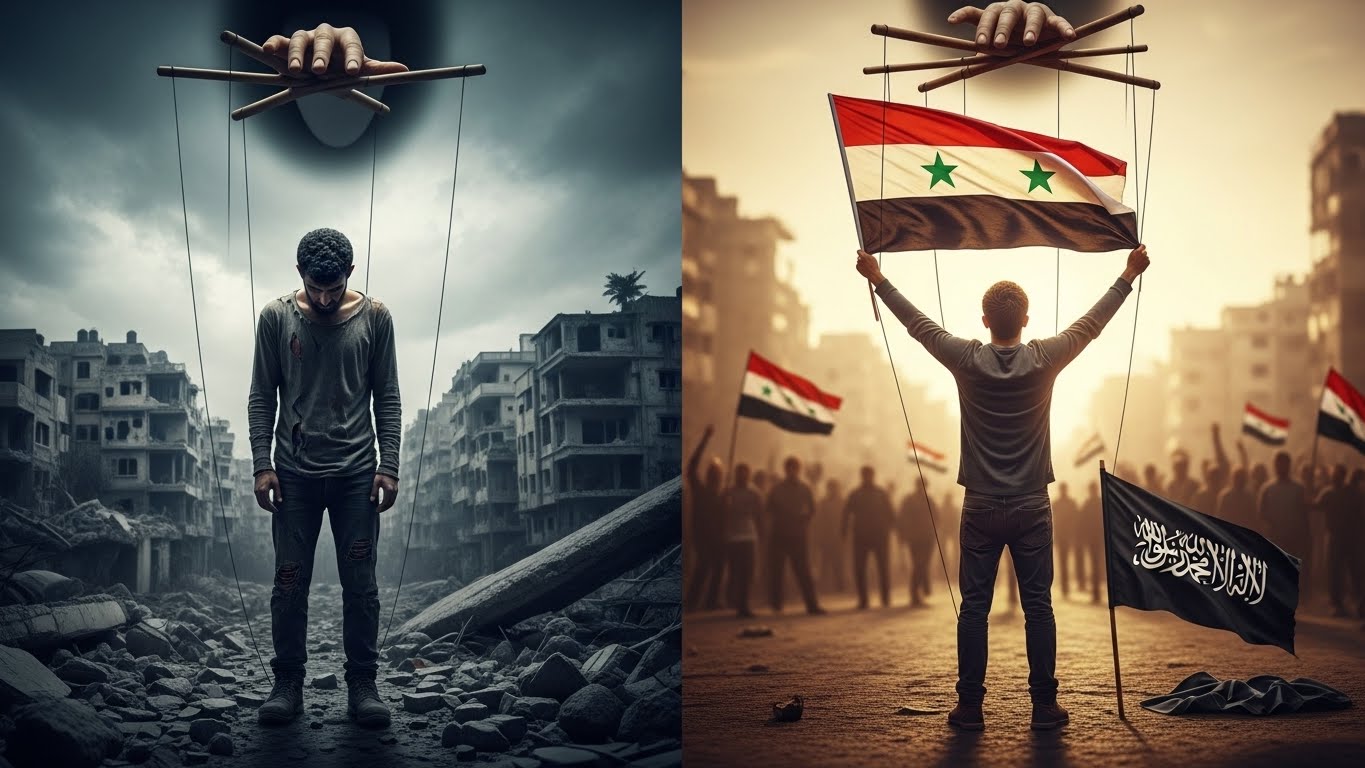
No one has the right to police the tears of a people who have bled for over a decade. When Muslims of Syria take to the streets in celebration—waving flags, chanting slogans, embracing one another in public relief—we are witnessing relief, exhaustion, and survival. It is the human need to believe that the suffering meant something.
After mass displacement, torture chambers, chemical weapons, starvation sieges, broken families, and stolen childhoods, people need meaning. They need to believe that history has turned a corner and that the blood was not spilled in vain.
This emotional truth must be acknowledged first. Any analysis that begins elsewhere is insensitive.
But acknowledgement is not the same as illusion. And honouring pain does not require us to suspend thought. Because once the tears dry, once the fireworks fade, and once the slogans quieten, a harder question remains—one that history has asked Muslims again and again:
Victory on whose terms?
The Illusion of Triumph
The lifting of sanctions is being framed as a breakthrough. A reward. A sign that Syria is “back.” For many, it feels like a vindication after years of collective punishment, economic suffocation, and international abandonment.
Yet sanctions are not lifted because morality suddenly triumphs over power. They are lifted when they are no longer needed.
Sanctions are a tool, not a principle. They are imposed to discipline, destabilise, or coerce and removed when integration, not isolation, better serves the system that imposed them. I am not saying this because of cynicism but understanding how empire functions.
If the United States and its allies—the architects and custodians of the modern global order—are easing restrictions, it is not because Syria has escaped that order, but because it is being reabsorbed into it.
History offers a consistent pattern: when resistance exhausts itself, when revolutionary energy fragments, when the threat shifts from defiance to disorder, the system does not crush—it absorbs.
Sanctions lifted. Markets reopened. Reconstruction contracts awarded. Loans issued. Conditions attached. Narratives softened. A new chapter declared.
The cage is repainted. The bars remain.
Shock, Trauma, and the Economics of Ruins
Naomi Klein called it The Shock Doctrine: moments of collective trauma are exploited to push through economic and political transformations that would otherwise face resistance. War devastates not only infrastructure but imagination. When people are desperate, stability—any stability—feels like salvation.
Syria today is one of the most traumatised societies on Earth. That makes it fertile ground for “reconstruction” narratives that mask privatisation, dependency, and foreign control. Sanctions lifted does not mean sovereignty restored. It means capital can enter. It means corporations can bid. It means resources can be priced, packaged, and extracted.
The question is not whether Syria will be rebuilt. The question is who will own the rebuild. And:
More importantly: who will define what “normal” looks like afterwards.
Fighting Colonialism with a Colonised Tongue
Perhaps the most telling image from these celebrations is not the crowds themselves, but the symbols they rally behind.
Flags designed by colonial cartographers. Borders drawn in imperial boardrooms. Political vocabularies inherited from those who dismantled Islamic civilisation and replaced it with nation-states engineered for control.
When a people overthrow a tyrant but inherit the conceptual framework that produced him, the revolution changes faces, but not the underlying machinery. When liberation is imagined only within the parameters provided by the coloniser it lacks the shift in civilisational consciousness needed to sustain the movement.
We remove the dictator but keep the system that required him. We celebrate sovereignty while outsourcing our economies. We chant independence while measuring success by Western approval.
The Real Battlefield: Control of Narrative & Meaning
Every major upheaval in the Muslim world over the last century has followed a similar arc. Uprising. Hope. International intervention. Rebranding. Reintegration.
The so-called “Arab” Spring was not defeated solely by tanks, prisons, and counter-revolutionary force. It was defeated far earlier—through narrative capture. Even its name reduced a civilisation uprising into a regional disturbance, confining the struggle within the boundaries of nationalism rather than framing it as a Muslim challenge to a global power structure.
Revolutions were translated into “transitions,” liberation into “stability,” and justice into “governance reform.” By the time dictators fell in places like Egypt, the terms of victory had already been rewritten. What was never permitted to emerge was an Islamic framing of power, economy, society, and purpose—one that did not seek approval, legitimacy, or reintegration into the very order responsible for our fragmentation and decline. The system did not need to crush the revolutions; it only needed to absorb them.
This is why the most important question today is not whether sanctions were lifted, but whether consciousness has shifted.
Are we thinking beyond survival? Beyond recognition? Beyond being “allowed back in”?
Or are we still negotiating our future using concepts, institutions, and aspirations defined by others?
A Window, Not a Destination
This moment is a window. That much is true.
History does not often pause. It rarely offers moments where outcomes are still fluid. Syria stands at such a moment—not because sanctions were lifted, but because meaning has not yet been settled.
Windows close quickly. They close when narratives harden. When celebration replaces strategy. When relief replaces reflection.
If this moment is framed merely as a return to normal, it will become exactly that—a return to managed dependency, economic subservience, and political containment.
But if it becomes a moment of conscious rupture—where Muslims collectively ask harder questions about power, sovereignty, and purpose—then even limited political change can yield long-term civilisational impact.
What Must Change—Even If Nothing Else Does
Even if Syria’s political economy remains constrained. Even if Western capital flows in. Even if the global system tightens its grip quietly rather than violently. Something must change.
Muslim consciousness cannot remain where it is.
We cannot continue to measure victory by access to markets. We cannot outsource legitimacy to foreign powers. We cannot grieve our martyrs while inheriting the frameworks that produced them.
If all that changes is infrastructure while our imagination remains colonised, then the pain was not redeemed—it was domesticated.
But if this moment produces a generation that understands how power truly operates, that recognises narrative as a battlefield, that refuses to confuse relief with liberation—then even an incomplete political outcome can seed a future rupture.
Empires fear weapons. They fear economies. But above all, they fear independent meaning-making because he who controls the narrative does not merely describe reality—he determines what is possible.
The Question That Will Decide Everything
So the question Muslims must ask is not:
“Have we won?”
But:
Who is defining what winning looks like?
So, what does winning actually mean?
If victory is reduced to the removal of a regime or the easing of sanctions, then we have set the bar naively low. Tyrants can fall while structures remain intact. Sanctions can be lifted while dependency deepens. Flags can be raised while minds stay colonised. This is not a civilisational definition of victory—it is one that allows the system to continue under a new adminstration.
True victory is not merely political; it is a shift in civilisational consciousness. It is not just the end of repression, but the end of fragmentation.
When Muslims in Syria wave a flag handed down by colonial cartographers, we must ask uncomfortable questions: where is the Libyan Muslim in this celebration? Where is Palestine? Where is the sense that our struggles are not isolated episodes, but one continuous confrontation with a global power structure that thrives on our division?
As long as we define ourselves through borders drawn for us, symbols chosen for us, and victories validated by those who once sanctioned our suffering, we are not free, we are being managed. Sanctions are lifted not when justice is achieved, but when resistance becomes predictable, containable, and economically integrable.
This moment is a window. But windows close quickly. If all that changes is who governs, while the underlying narrative remains untouched, then the pain of millions will be to simply change the exterior of the chains that keep us oppressed.
Winning, then, must be redefined: not as survival within the system, but as the awakening of a single consciousness:
One people, One struggle, One direction.
We only win when we speak as one, move as one, and refuse to fight oppression in the language of our oppressors.
If the answer to “What does winning mean?” remain external, then this is a blip in the global western power structure. If the answer begins to shift inward, this window may yet become a door.